How to reach Kedarnath
The journey to Kedarnath can be done via road, or by air. For Road, you can check the route we followed and for the helicopter services from Haridwar/ Rishikesh or Phata, check here.

The nearest airport is at Dehradun whereas the nearest railway is at Haridwar or Rishikesh. Further, the journey to Sonprayag from Dehradun is 252 km, from Haridwar is 237 km and from Rishikesh is 212 Km.
Route from Haridwar till Sonprayag:
Route 1 (295.5 Kms) Haridwar – Rishikesh – Devprayag – Srinagar – Rudarprayag – Agastmuni – Guptkashi – Phata – Sonprayag
From New Delhi
Buses go to Haridwar almost every half an hour. Road takes 8 hours. Also you can go by train, this will take 4-6 hours. From Haridwar you can go directly to Kedarnath but it is also possible to stay there at least one day – this beautiful city is placed on Ganga. If your group is more then 5-6 persons you may think about renting a jeep. If jeep is fast enough then you can reach Gaurikund in 9-10 hours. Please note that road from Rishikesh to Gaurikund will be closed from 8 pm to 4 am.
Kedarnath from Haridwar
From Haridwar every day morning buses start to Gaurikund. Advance bookings can be made at GMOA (Garhwal Mandal owners Association) office in front of the railway station. It takes almost one full day journey to reach Gaurikund if there are no Landslides. Bus journey is very beautiful because most of the 295.5 kms is ghat road journey with many mountains around and river Ganges following you through out the way.
Road Conditions till Sonprayag
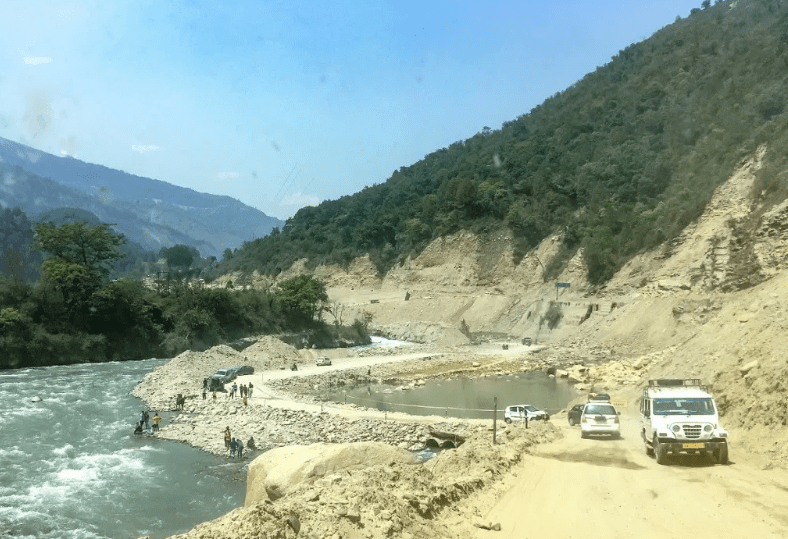
Roads are good and there are many rough patches too. Expect few landslides on the way and at times you will be taking detours and driving just at the River bed. Char Dham Highway project, NH-58 i.e. four-lane roads for 900 kilometers, connecting 4 Dhams i.e. Badrinath, Kedarnath, Gangotri, and Yamunotri is on the go, so there are many roadblocks and traffic will be slow on the way.
Sonprayag to Gaurikund
Further, from Sonprayag; Gaurikund is around 6 Kilometers and can be reached via shared cabs only. Park your vehicle in the parking and move towards the registration counter. After registartion, walk for around 500 metres and you will see cabs there. Driver charges Rs.20 per head in a shared cab and jump in. It is the most economical means of transport.
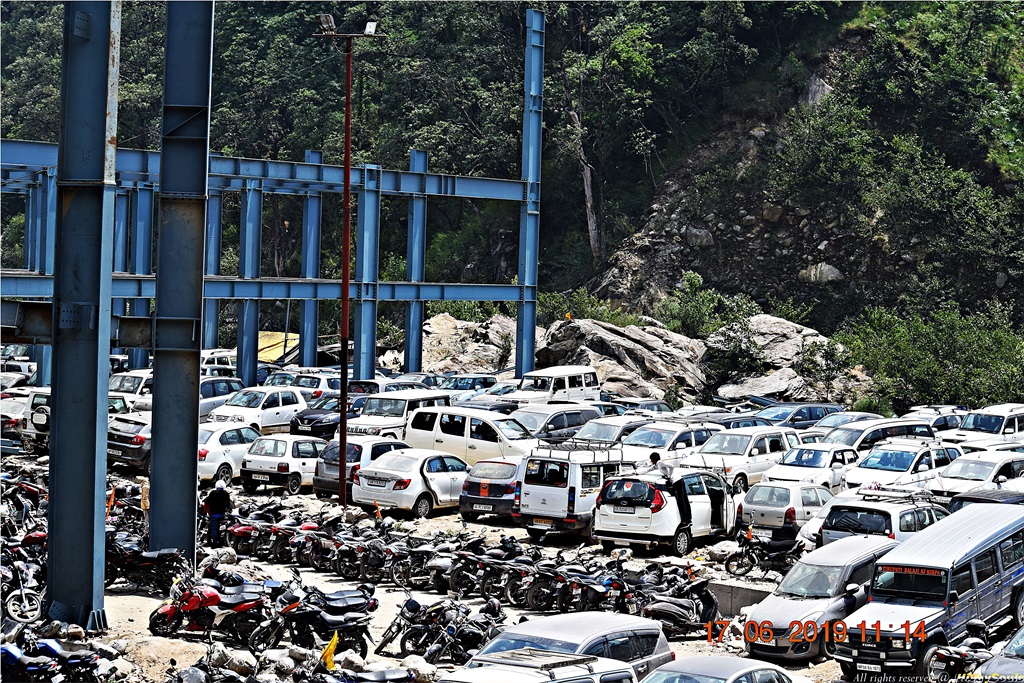
Gaurikund serves as a base camp to Kedarnath Temple and once you debark here the real trek to Kedarnath Temple begins.
Gaurikund to Kedarnath Temple
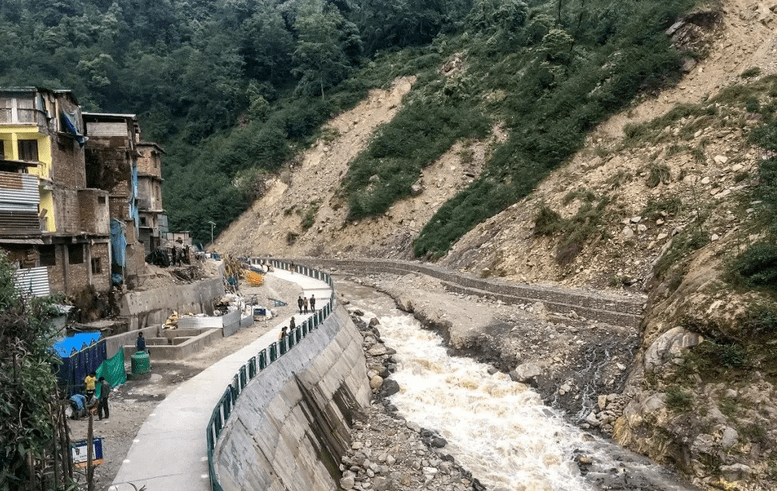
Before the trek to Kedarnath Temple was of 16 kilometers via Rambara but North India floods in 2013 completely destroyed the older route between Rambara and Kedarnath. So, the new route laid down now is of 16-17 Kilometers till Kedarnath Base camp (i.e. till the point where horses go, also known as Ghoda Phul).
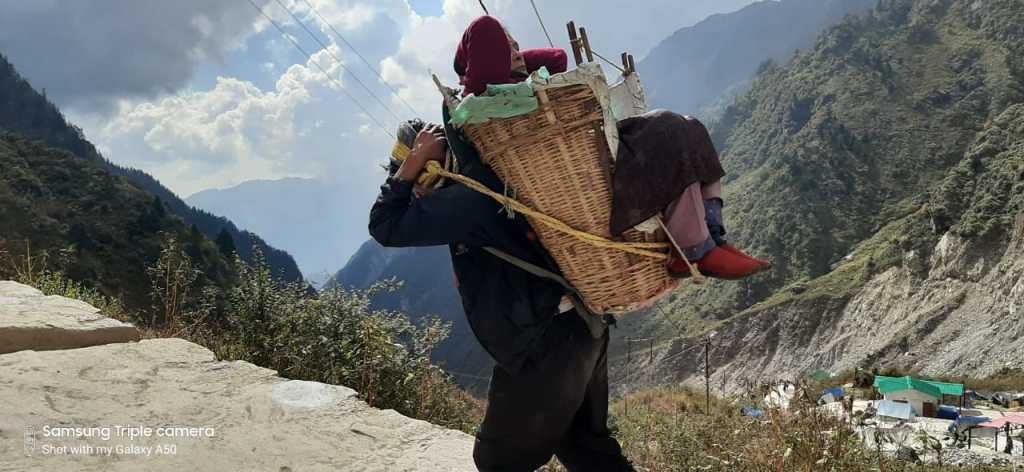
From Kedarnath Base camp, there is further a walk of 2-3 kilometers till Kedarnath Temple and the same can be done via, walking, Palki (Palanquin) or Pithu’s only.
Complete new route map of Kedarnath Trek
Gaurikund – Rambara Bridge (7 Kms) – In between comes Jungal Chatti and Bheembali
Rambara – Linchauli (4 Kms)
Linchauli – Kedarnath Base Camp (3-4 Kms)
Kedarnath Base Camp – Kedarnath Temple (2-3 Kms)

Facilities on the way to Kedarnath Trek
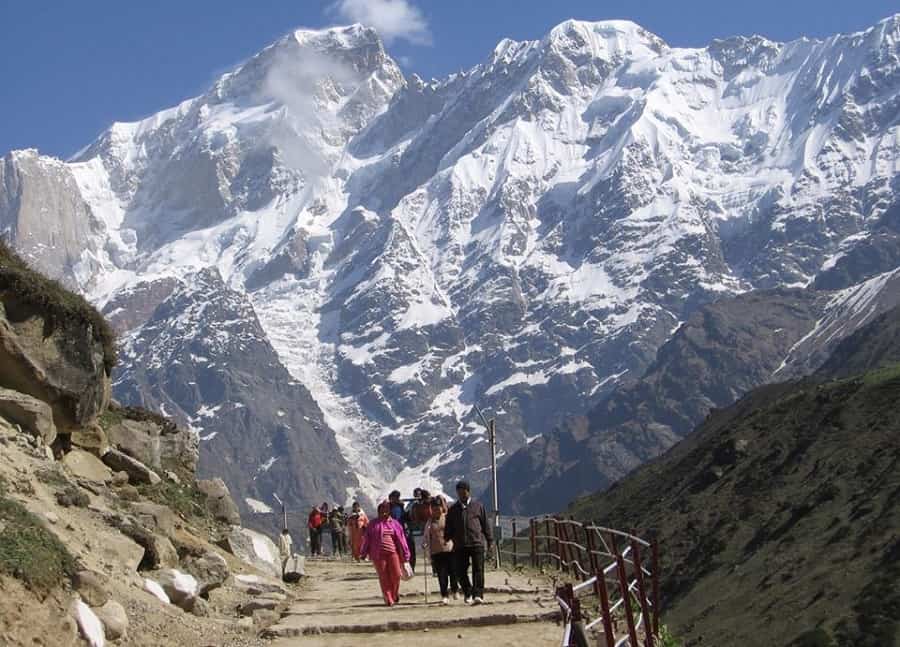
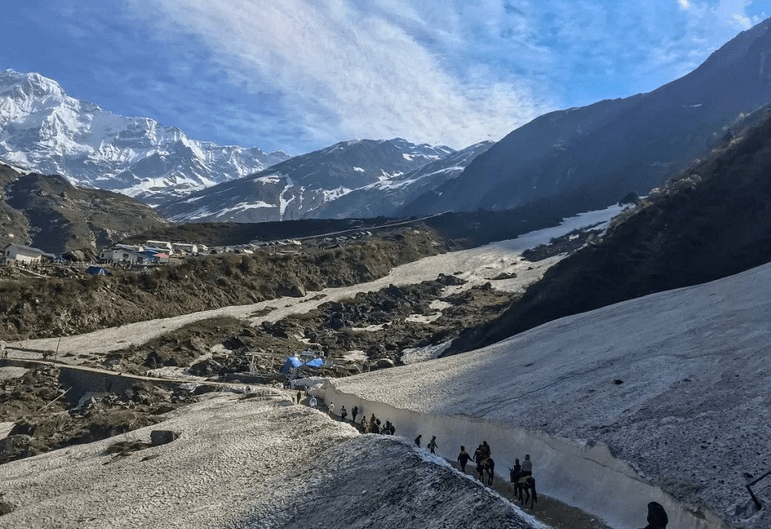
The Kedarnath track is paved and barricaded except at the few patches. In the midst of the trek, there are shelters, proper medical facilities, tented accommodations, drinking water, and small shops/ restaurants.
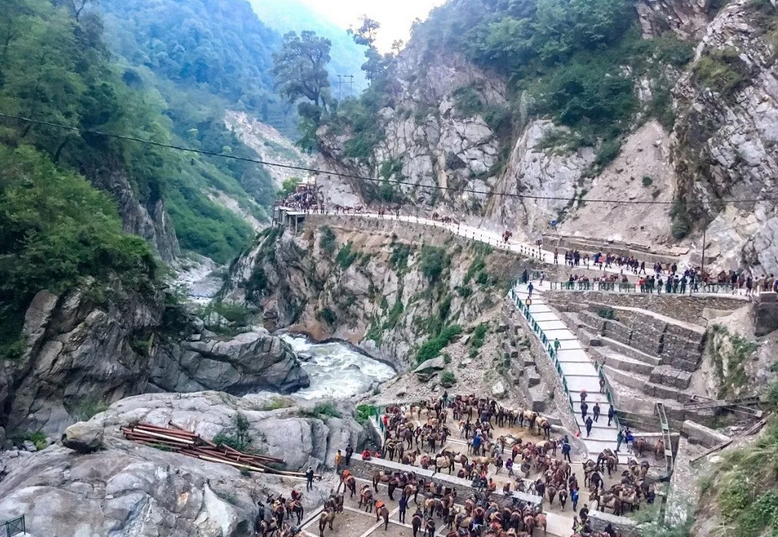
Horses/ Ponies/ Palki/ Kandi / Helicopter
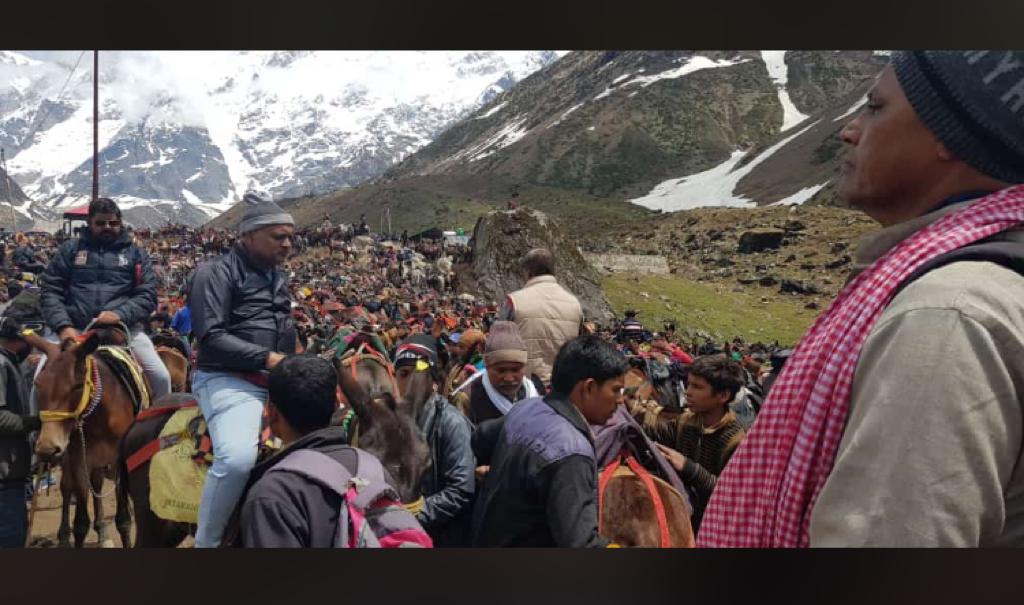
Horses, Palki, and Kandi services are available at the base camp as an alternative to trekking. Remember you can get horses/ ponies easily at the base camps but the chances of getting them on the way are bleak; whereas Kandi and Palki service is available throughout. Rates for Horses/ Ponies is Rs.2300/- from Gaurikund base camp to Kedarnath base camp and Rs. 1500/- for vice versa. Whereas rates for Palki and Kandi varies with weight and you can refer the below chart for the same.

The Helicopter services to Kedarnath are available from Guptkashi, Phata and village Sersi. Helicopter drops the pilgrims just behind the temple and for the revised rates, refer here.
Medical Services
Special arrangements for medical services has been made by the health Department at all the main stops i.e. at Jungle Chatti, Bheembali, Linchauli, and Kedarnath. Doctors are available for 24 hours and there is an arrangement of medicines, oxygen cylinders, telemedicine and even airlifting. There is also a 10 bedded hospital with ECG and other modern facilities at Kedarnath.
Accommodation
Accommodation on the way is available at Jungle Chatti, Bheembali, and Linchauli. At Bheembali there is GMVN Bheema Complex and at Linchauli, there are Shivlok Cottages. At Kedarnath, there are several accommodation options. We stayed at Agra Bhawan, which is just next to Kedarnath Temple.

Shops & Restaurants
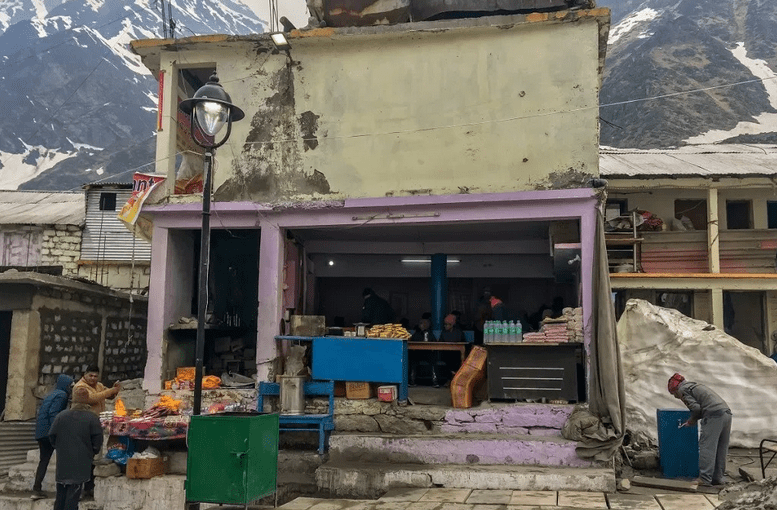
There are several shacks and restaurants on the way of supplying cold drinks, buttermilk, biscuits, Maggi, and food. The pricing is higher than the regular pricing but it’s worth as it is tough to get and maintain regular supplies here.
Best time to visit Kedarnath Temple
Kedarnath is cold during most of the year and weather too changes here drastically. So, the best time to go is May- June, and September – October. Avoid going during monsoons i.e. July – August as there are heavy rainfall and high chances of landslides.
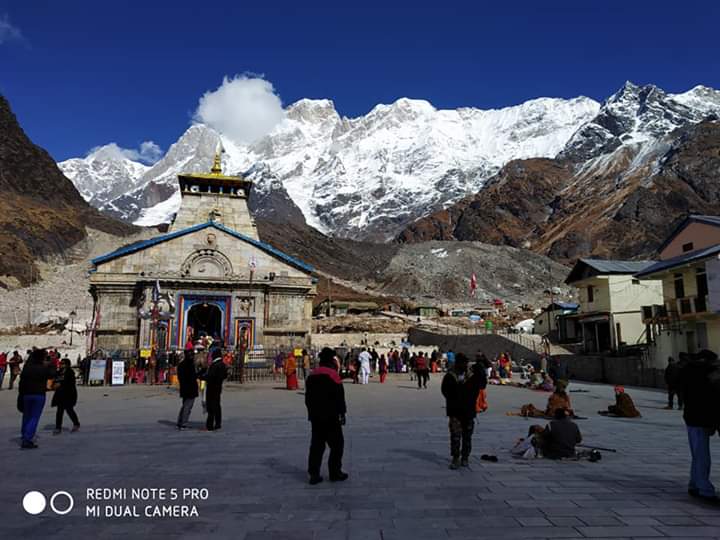
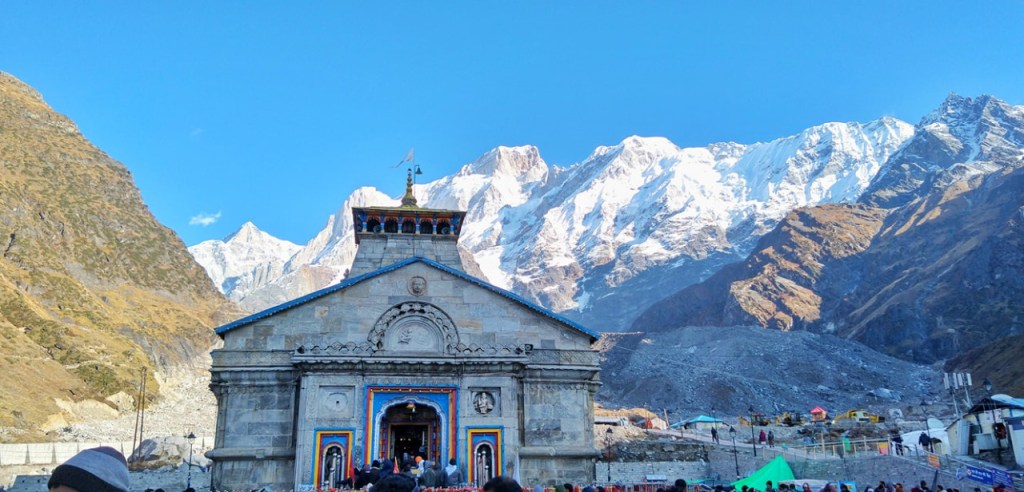
Kedarnath Temple opens up on the auspicious day of Akshay Tritiya (which falls in April – May) and closes on Bhai Dooj i.e. after Diwali (October – November). In 2020, the temple opened up on 28th April and probably will close on 16th November.
Temple Timings are: 4:00 am -9:00 pm
Timings for Kedarnath Trek
Because of the unpredictable weather conditions, there are fixed timings for Kedarnath Yatra too. One cannot go up from Gaurikund base camp after 1:00 pm and cannot trek back from Kedarnath base camp after 5:00 pm.
Trek Level: Steep and Tough
Registration for Kedarnath Trek
As soon as you park your vehicle in Sonprayag and move from the parking there is a Biometric Registration counter. There is a separate queue for men and women. The police personnel sitting behind the window will ask you for I- card verifies your details, take a picture and issue a Char Dham, Yatra Card. The whole process takes around 15-20 minutes.
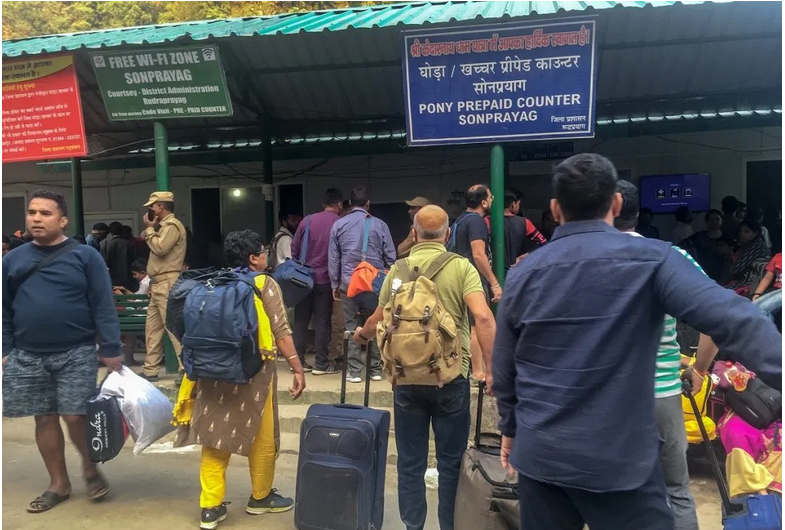
Just adjacent to this counter is a prepaid booking counter for horses/ ponies/ palkis and Dolis. One can book the same from here or from Gaurikund counter. We booked for ourselves from Gaurikund at the fixed government rates only.

About Kedarnath Temple
Kedarnath; is formed from two Sanskrit words where “Kedara” means field and “Natha” means Lord. So, it is known as a place where the “Crop of Liberation” grows.
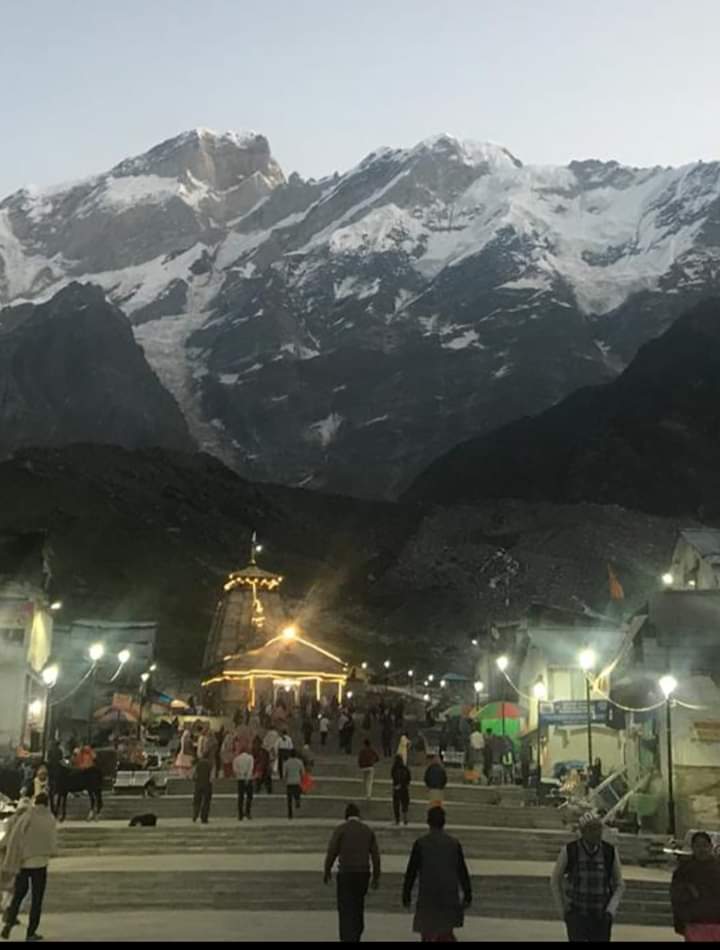
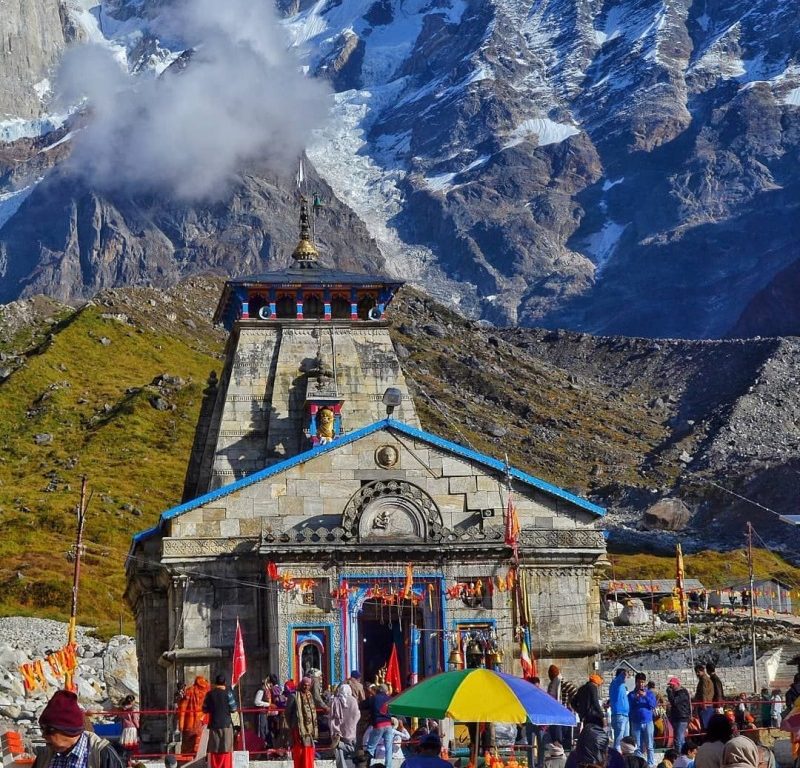
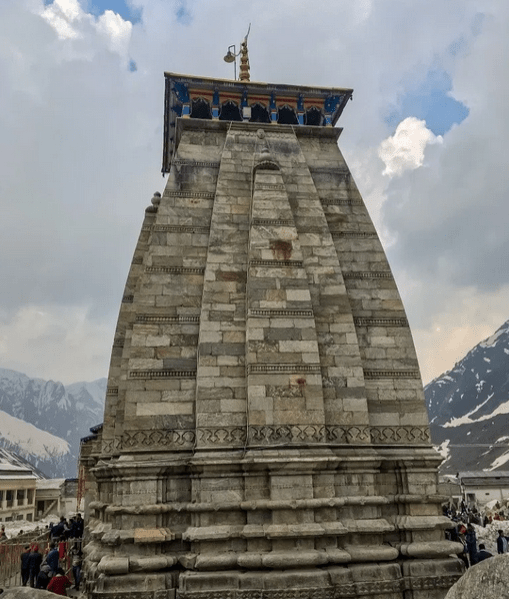
The Kedarnath Temple is located at 11,755 feet in the Garhwal Himalayan range of Uttarakhand, on the banks of Mandakini River (a tributary of Ganga), near the Chorababari glacier. It is a Hindu Temple (Shrine) dedicated to Lord Shiva and is also one of the Jyotirlinga. The temple is 85 feet high, 187 feet in length and 80 feet wide. Its walls are 12 feet thick and are built from extremely strong stones.
Tokens for Kedarnath Temple
For a visit to Kedarnath Temple, one needs to collect the Tokens. They are available at the Kedarnath entry gate, near the market. Remember, the token is for one person only and the collected token is valid for the same day Darshan only. After getting your token, wait for your number to be displayed on the display board.
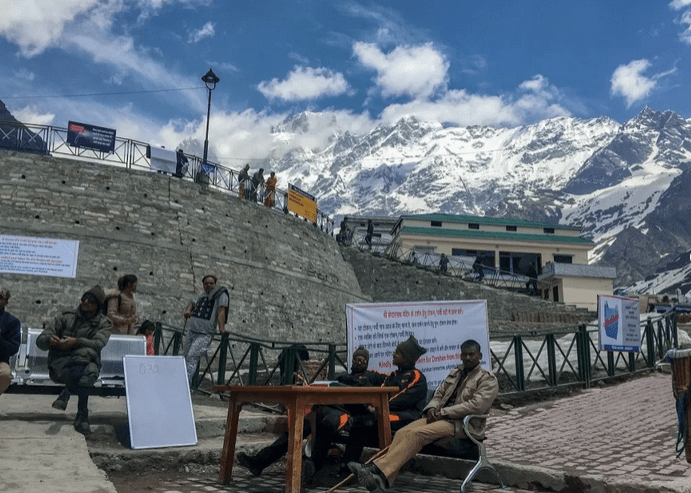
Note: For the next day you need to collect new tokens and the personnel’s are available form 5:00 am to 6:00 pm.
Story of Kedarnath Dham
There are several stories of Kedarnath Temple. Some claim it to be built by Guru Adi Shankaracharya in the 8th century whereas others claim it to be built by Raja Bhoj of Malwa in the 2nd century.
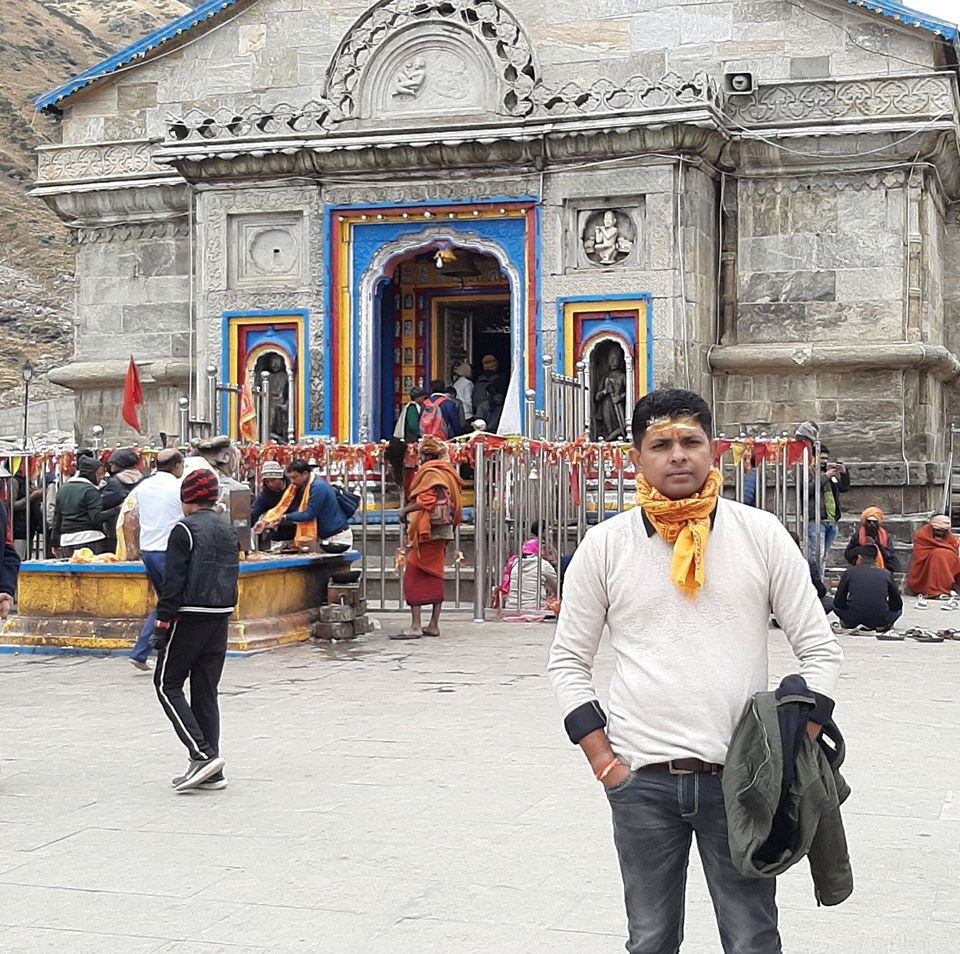
Acc. to Hindu mythology, the temple was initially built by Pandavas. Pandav Brothers after killing their kin during the Kurukshetra war, wanted to seek forgiveness from Lord Shiva but Shiv was not interested in meeting and forgiving them. So, the Lord Shiva left Kashi his abode and came to dwell in these Himalayan range at Guptkashi. However, Pandavas got to know about his presence and they reached here too. To further hide, Lord Shiva turned himself into a bull and got mixed with the grazing cattle. But the Pandavas especially Bhima being too smart tracked Lord Shiva, and on realizing this Lord Shiva tried to disappear by sinking himself head-first into the ground. One of the brothers grabbed his tail and hind limb, forcing him to appear and forgive them. So, the hump is found at Kedarnath whereas the rest body parts are found at four other locations and together these places are known as Panch Kedars.
There is another Hindu story, in which a Hindu Deity Nar Narayana performed a severe act of austerity and on getting pleased, Lord Shiva appeared in front of them to grant their wish. The Deity requested Lord Shiva to stay here in the original form i.e. Jyotilingam for the welfare of humanity. Shiva granted their wish and Kedarnath became his abode.
Now, the most Interesting story is that Geologist believes that the Kedarnath temple remained hidden under the snow for 400 years during the Little Ice Age era i.e. from 1300to 1900 AD. The yellow lines on the temple structure completely depict the glacial activity it had undergone.
Inside Kedarnath Temple
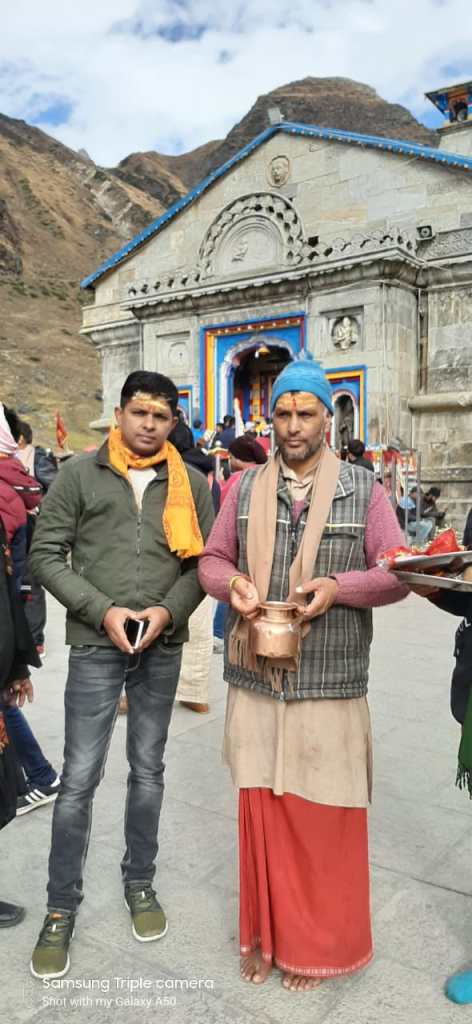
Kedarnath Temple is an ages old stone temple. Its architecture truly looks quite stout and that has been proved, as it still stands magnificently even after all the natural calamities and catastrophes.
Climb 3-4 stairs and you enter the first hall of the Kedarnath Temple. The Temple is dark and gloomy form inside, It houses statues of the five Pandava brothers (Bhim, Nakula, Yudishitra, Arjun and Sahadeva) and their consort Drapudi, Lord Krishna, Nandi- the vehicle of Shiva in the center and Virabhadra (one of the guards of Shiva). Another beautiful silver door decorated with Om makes you enter the main hall. In the center of the main hall, is a conical or triangular shaped stone considered to be the Dhad (Torso) of Lord Shiva. The stone was completely covered in ghee and butter by pilgrims. Earlier the pilgrims used to pour milk and water on Shivlinga but now the management has stopped it. The statue of Shiva and other deities are also installed in the main hall.

Outside Kedarnath Temple
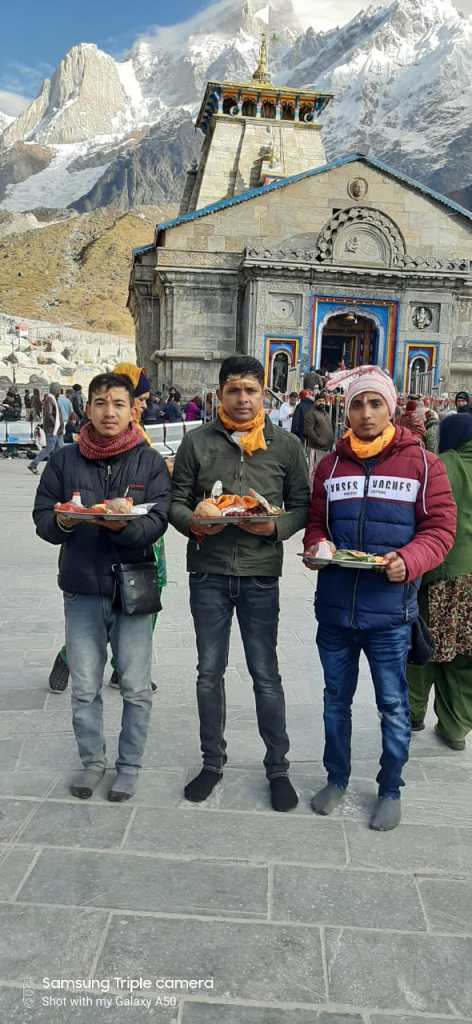
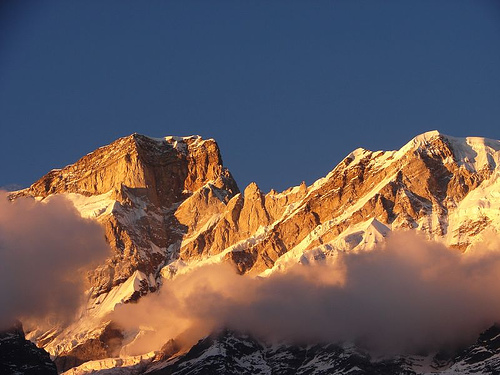
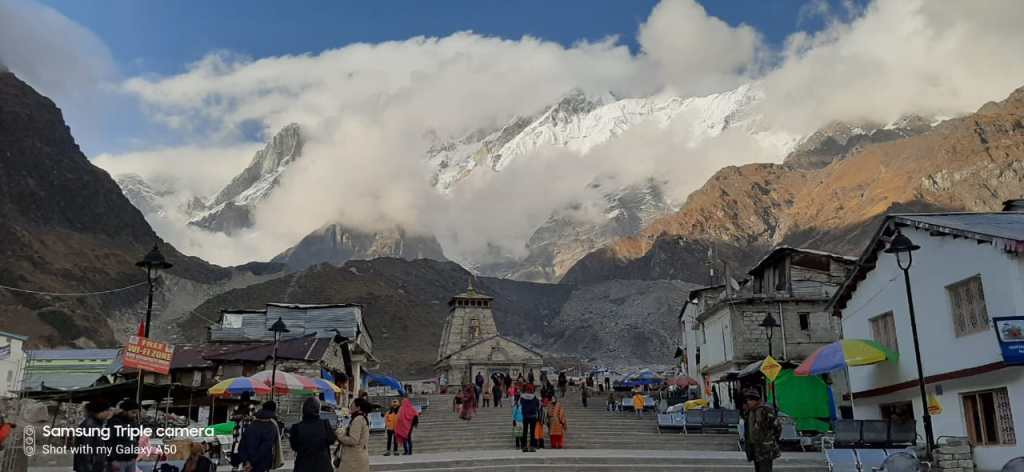
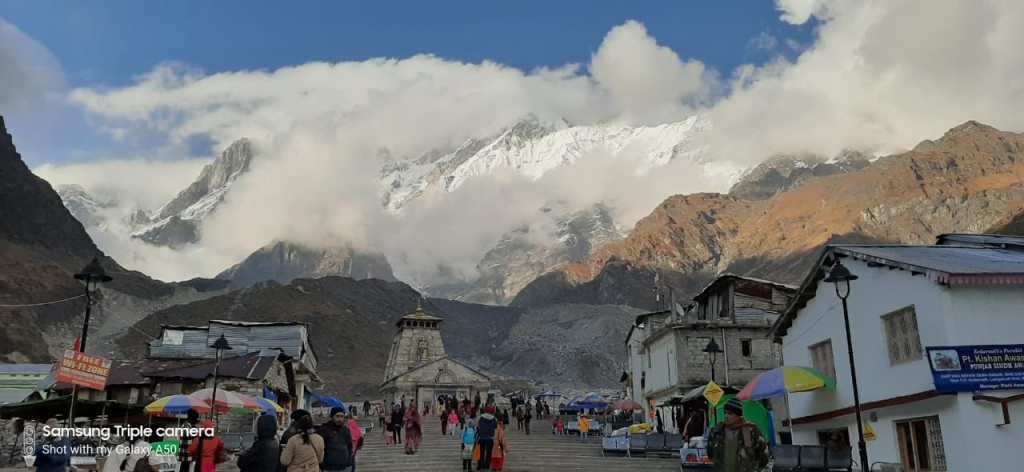
As you step out the temple and start circumvallating around the temple; you will see the temple is surrounded by snow-covered peaks from all three sides. On the front, there is a huge statue of Nandi.
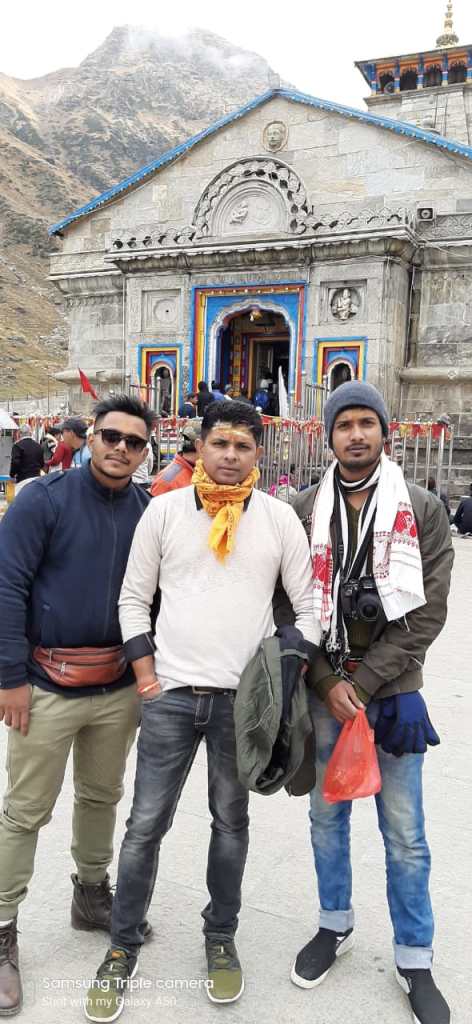
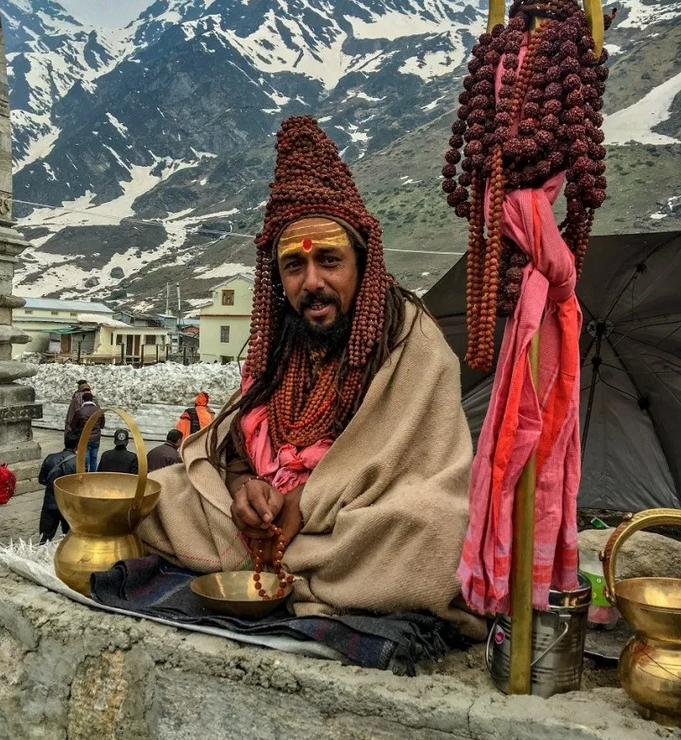
And rest on all the sides, dozens of Sadhus and Saints, half-dressed half naked are sitting in various colorful attires. They are Lord Shiv devotees and live a hard tough life, like him.
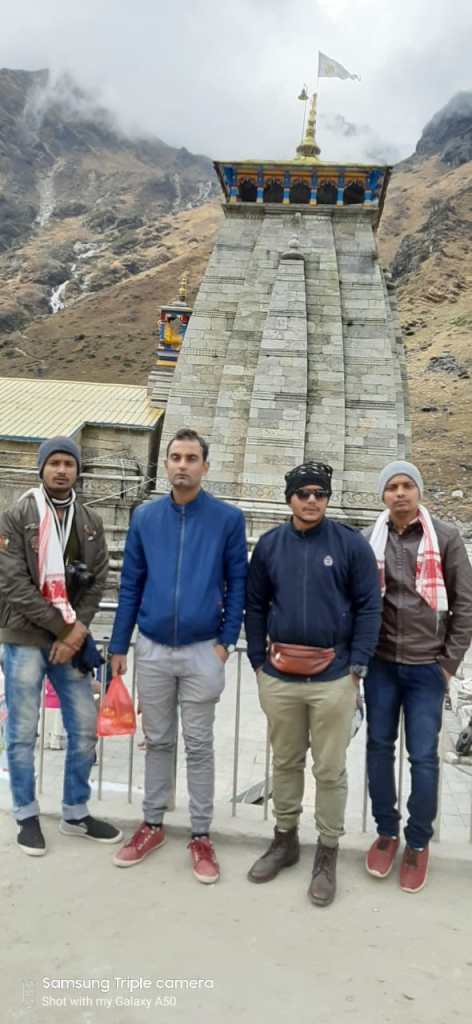
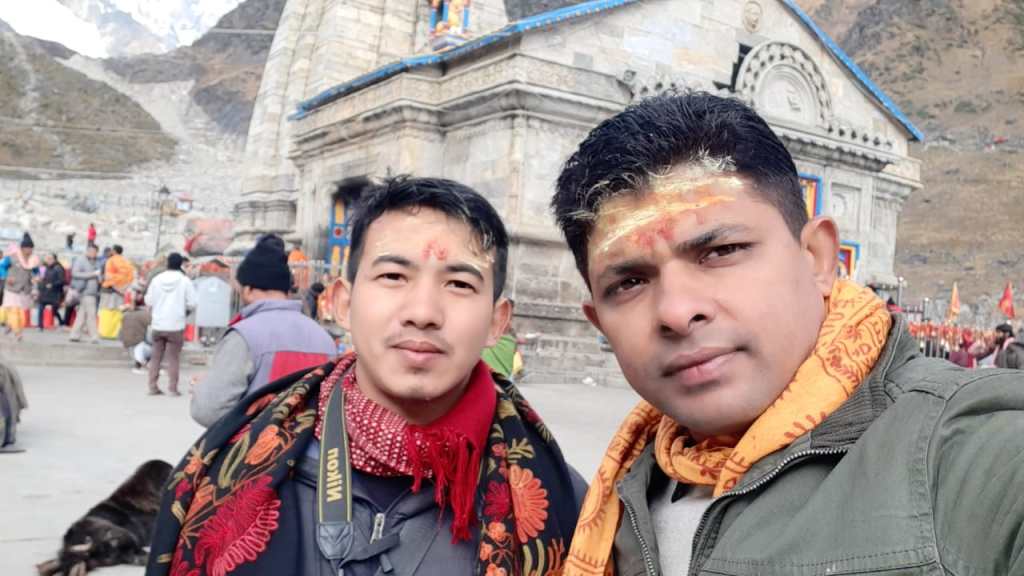
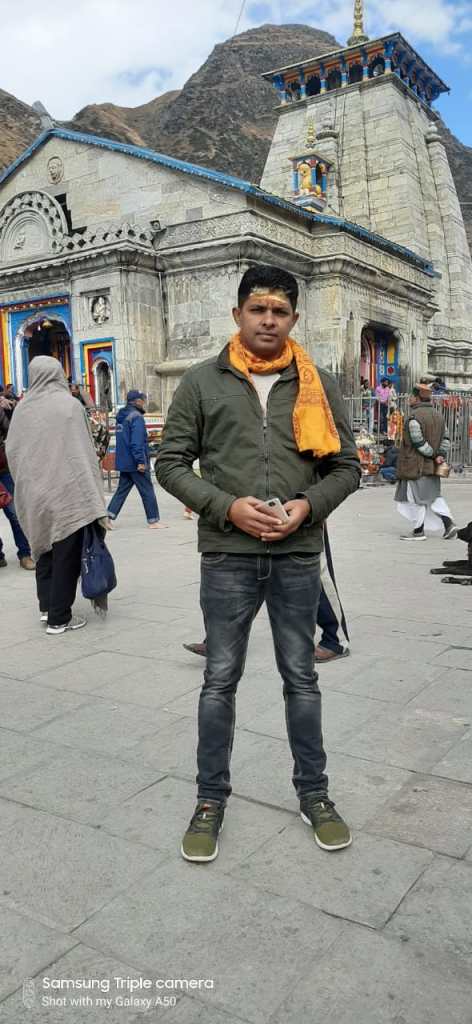
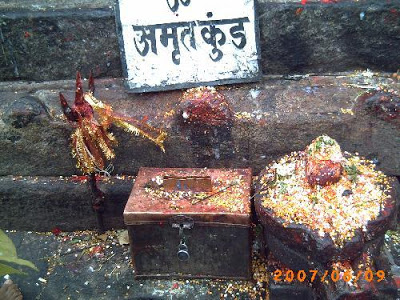
On both sides there are beautiful colorful doors which resemble the ones from Badrinath Temple and at the back is an Amrit Kund. Some Pilgrims just wanted to just touch and taste this water whereas others wanted to fill the bottles and take back home.
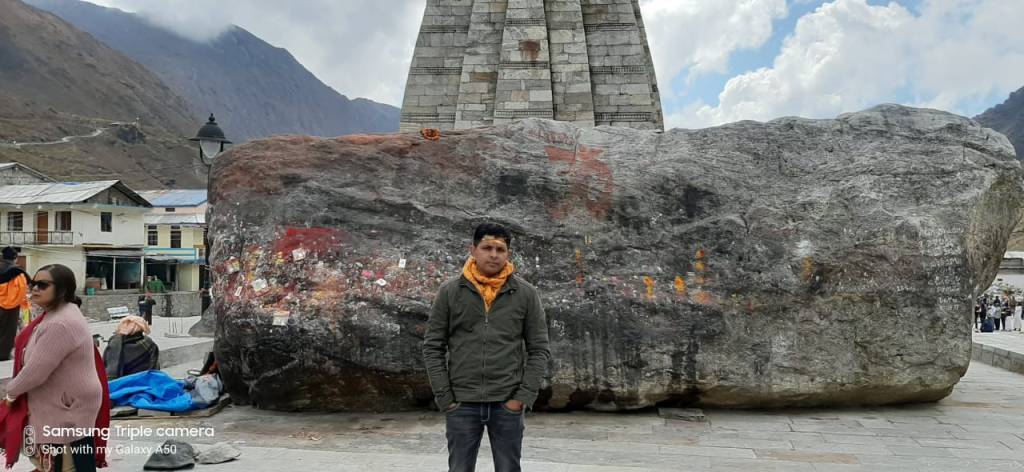
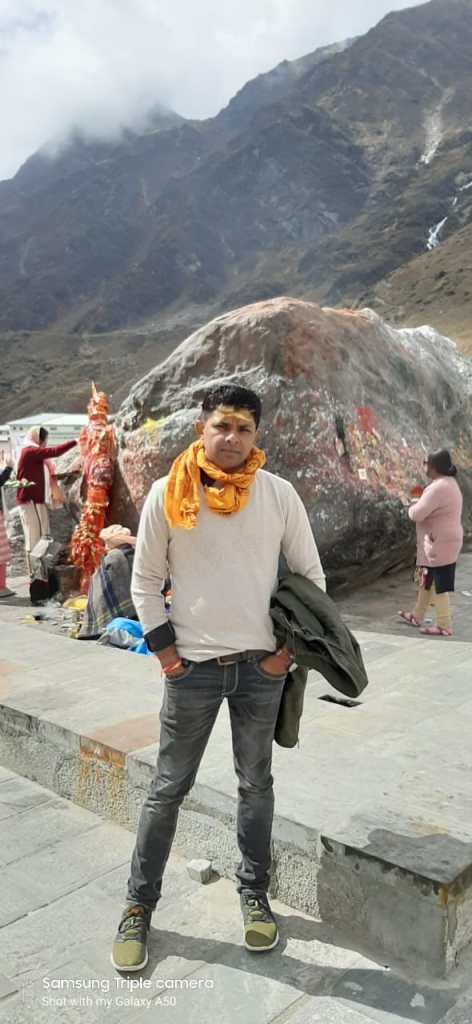
Just Like Bheem Shila in Mana village near Badrinath temple, there is a huge Shri Divya Bhim Shila behind the Temple. This stone is believed to be the one which protected the temple from devastation during 2013 North India flash floods. But the locals or priests have another story to it. They believe the Shila is just another stone which came down during natural calamity towards Kedarnath Temple and it is the pilgrims who have made a temple around it and now consider it to be sacred.
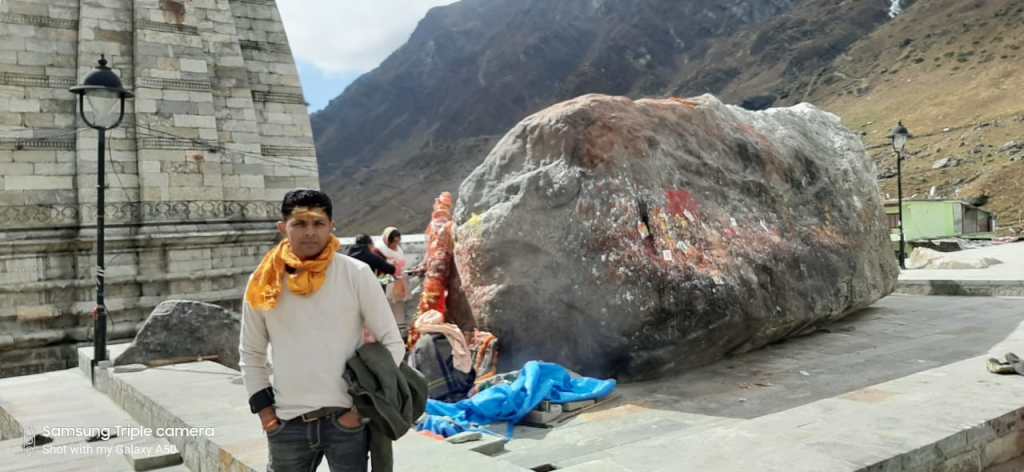
Accommodation at Kedarnath
At Kedarnath, there are several accommodation options from Hotels to guest houses to Bhawans. During our visit, only a few of them were operational whereas the others were closed or in bad shape due to the extreme snowfall in winters. The government claims to have made an arrangement of 3000 pilgrims but we really doubt that.
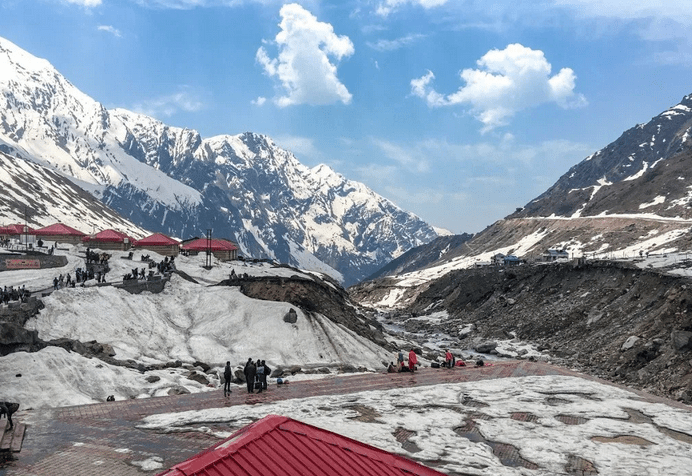
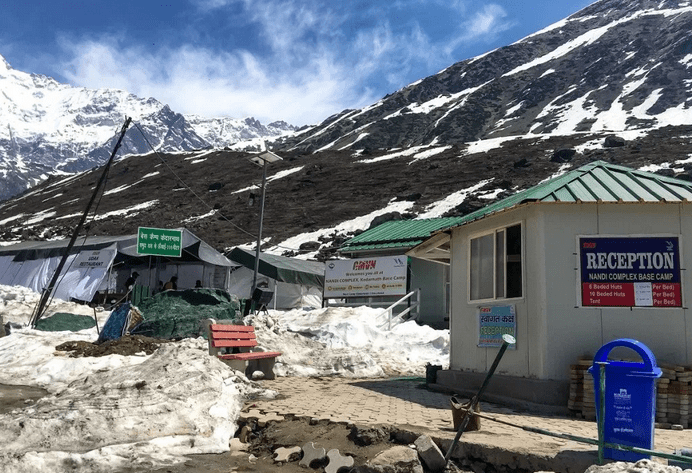
GMVN (Garhwal Vayu Mandal Nigam) the government authorized tents were also operational at Kedarnath but they were far from Kedarnath Temple and charges were Rs.900/- per bed for 6 Bedded huts, Rs. 750/- per bed for 10 Bedded huts and Rs. 300/- for tents, with common sharing washrooms.
We stayed at Agra Bhawan, just next to the Temple, where a four-bed room with attached washroom costed us Rs. 3000/- and 1 bucket of hot water costs around Rs.80/-. Another good option we recommend to stay is Himachal Bhawan just opposite to Agra Bhawan and near to Temple.

Food and Market at Kedarnath Dham
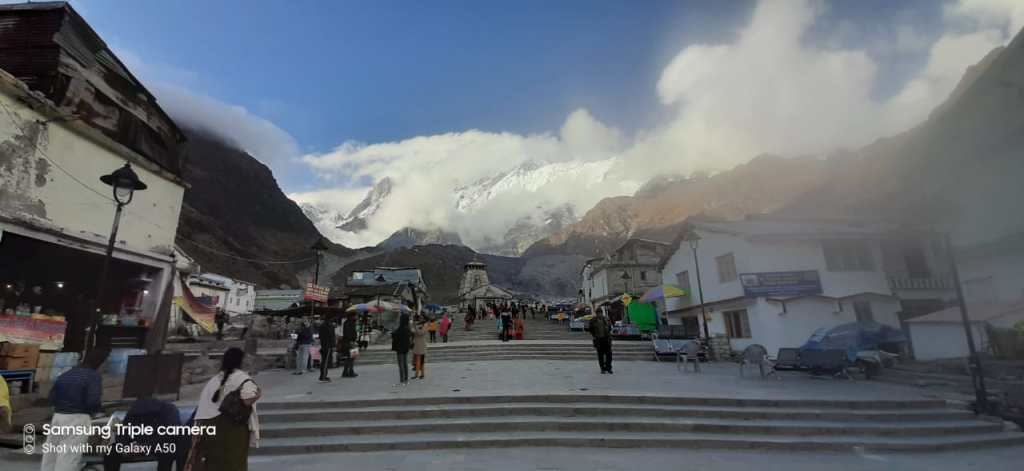
As you leave the Kedarnath Temple and move down the stairs, starts the Kedarnath Haat Market. During our visit, there was lots of snow around the shops and the whole of the market looked closed only.
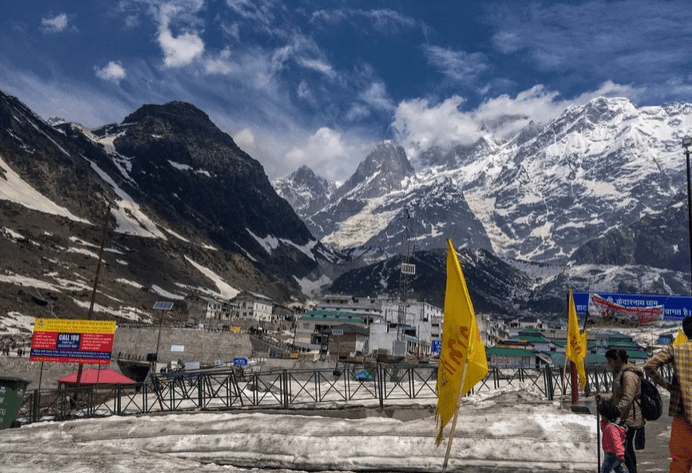
20-25 steps down from the Kedarnath Temple is a food shop which serves Indian food, Tea, snacks, etc. Just opposite to it there was another operational Dhabha.
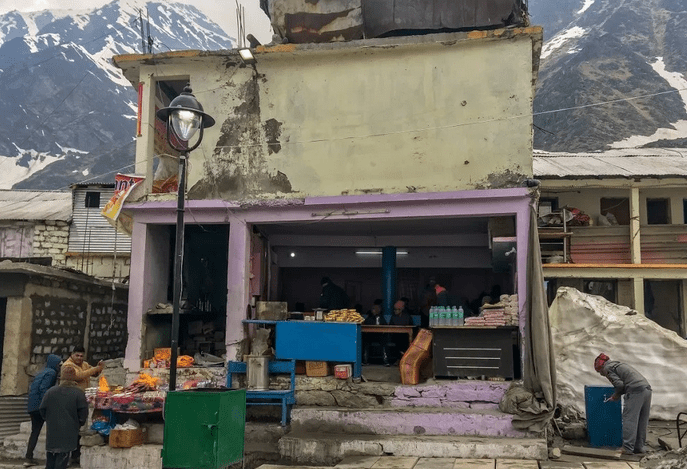
Another option for getting food is the guest house or Bhawan, where you are staying at but we opted to have it in the market itself.
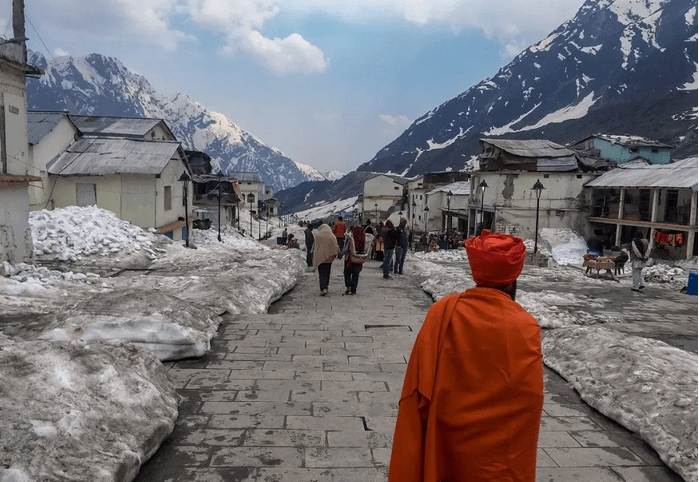
Weather at Kedarnath
Kedarnath is really unpredictable in terms of weather. If one moment it is sunny, other moment weather can take a twist and it will be snowing. You will find banners everywhere on the route quoting you to carry Warm Clothes, Raincoats, and Umbrellas with you, and they actually make a lot of sense. We experienced all types of weather in a single trip.

Here, the Day temperatures varies between 5- 10 degrees Celsius whereas the night temperatures can go low to -5 degree Celsius too.
What you need to wear for Kedarnath Trek
For Kedarnath trip, one needs to pack and wear clothes in layers. While walking or at some places you may feel hot and removing layers but be really cautious. The clothes you must wear are:
- Inner Layer
- T- Shirt
- Fleece Layer
- Jacket (Wind and water proof)
- Gloves and Cap
Packing for Kedarnath Temple Trek
At Kedarnath Dham, you have limited options for everything from living to food, so just pack a small backpack. The must in the backpack should be a towel, toiletry kit, an extra pair of your clothes, medicines and a small portion of energy food like nuts, chocolates or energy bar.
In case of emergency, there is a medicine shop and relief center at Kedarnath, from where one can make a purchase.
Facts about Kedarnath Temple
- Just like Badrinath Temple, Kedarnath Temple is a part of Badrinath and Kedarnath Temple act
- The head priest of Temple belongs to Karnataka and is known as a Raval
- Raval does not perform the puja in the temple. The pujas are carried out on the instructions of the Raval by other priests.
- The Raval moves with the deity to Ukimath during the winter season
- About 6000 pilgrims visit Temple every day during the season
- Temple opens for only 5-6 months and during rest months it is engulfed among the snow
Places around Kedarnath Temple
Bhairon/ Bhairav Nath Ji Temple
The Bhairo Nath Temple, located at a very short distance from Kedarnath Temple is known as a guardian of the Kedarnathji. It is believed that Bhaironathji guards the Kedarnath Temple by keeping away the evil while the temple remains closed. Therefore the Bhairon Nath Temple is visited ceremoniously at the opening and closing of Kedarnath.

During our visit, the Bhairav Nath Temple was yet not opened. So, the Aarti ceremony was not performed at the Kedarnath Temple.
Kunds at Kedarnath
It is said that there are several Kund at Kedarnath but still many of them haven’t been revived after the 2013 Disaster. The one we could see clearly was Google Kund.
Google Kund
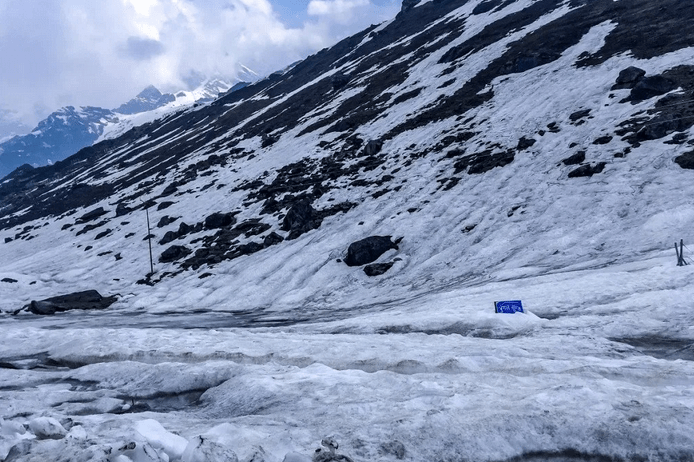
Around 0.5 Km from Kedarnath Temple, there is an interesting semi-frozen Kund known as Google Kund.
Chorabari Sarovar / Gandhi Sarovar
At a distance of 3 kms from Kedarnath Temple, at 12,795 feet lies a beautiful lake known as Chorabari Sarovar or Gandhi Sarovar fed on Chorabari Glacier. The trek to Lake passes through green grasslands and it is advised to carry the trek during the morning only as temperature and weather changes here drastically.
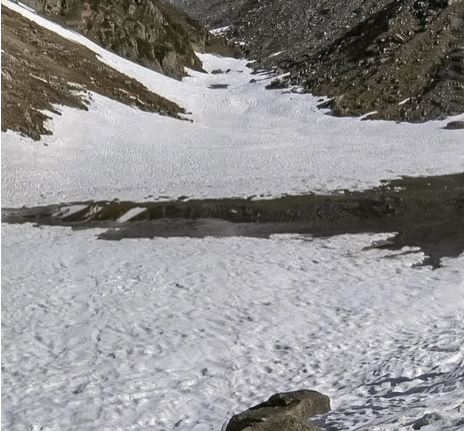
The Sarovar was initially known as Kanti Sarovar and was renamed to Gandhi Sarovar in 1948 when ashes of Mahatma Gandhi were immersed into the Sarovar. But now, no more the lake exists as the glacier has resided.
Vasuki Tal
Vasuki Tal lies at 13, 566 feet and can be reached by trekking for 8 Kms from Kedarnath Temple. The trek is said to be extremely steep, difficult and can be carried only under supervision. Vasuki Tal is surrounded by high mountain peaks and offers a view of Chaukhamba peak.

There are several beautiful, colorful flowers around the Vasuki Tal and one of the famous flowers is Brahma Kamal. During winter the lake it is completely frozen.
Rudra Meditation Cave/ Modi meditation Cave
Around 1.5 kilometers from Kedarnath Temple, at GMVN, in isolation are available underground mediation caves known as Rudra or Modi Meditation caves. The caves have a window for the direct view of Shrine and can be booked at Rs.990/- per day, for a maximum period of 3 days. They are equipped with electricity, water, heater, attached toilet, and phone to call authorities in case of emergency.

Before dwelling into the cave, one needs to undergo a medical test at Guptakashi and only those found medically fit can stay here. And only one person can stay at a time inside the cave. For more details and bookings check here.
Shankaracharya Samidhi
The resting place of Adi Shankaracharya is an extremely renowned place in Kedarnath. The hot water spring present there is believed to remove all the suffering of the devotees.
Places to stay in Base Camp Gaurikund
There are several hotels, guest houses and Bhawans to stay in Gaurikund but if you have no prior bookings then availability will be completely on your LUCK. We went prior booking and trust me, we had a tough time in finding one for ourselves. Finally, we got a room in the market at Subash Hotel, with attached washroom. 4 of us (We and our parents) accommodated in a 3-bedroom which costed us Rs. 1500/. And a bucket of hot water cost us Rs. 60/- per head.
Note: Hotels, guest house people don’t take advance bookings in Gaurikund, even on giving advance and pricing changes every day. The maximum they can charge is Rs.3000/- per night.
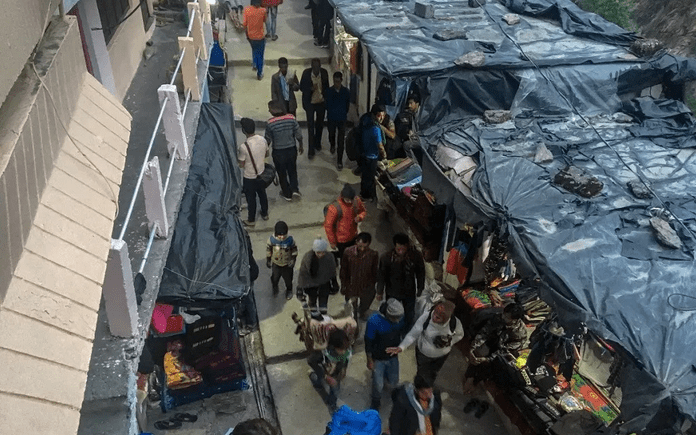
The tip to remember here is bend forward while climbing upward and bend backwards while climbing down and hold the saddle tightly.
Things to Remember before taking up Kedarnath Trek
- Check the weather forecast before planning the trip. Also, inquire about the weather at Sonprayag check post and then at Gaurikund check post. Further government has made special rules for the continuation and discontinuation of the trek.
- Get a medical checkup done before going for a Kedarnath trek
- People with respiratory disorders, cardiac disorders, and high blood pressure should take special care
- Remember while trekking to Kedarnath doesn’t exert yourself too much. Do not lose your breath while walking and halt if you think that you are experiencing shortness of breath.
- Hire a pony/ horse/ palki from the base camp itself, if you have made up your mind to trek with them. Also check, your horseman is not less than 18 years, as they are not allowed to ride passengers up and down
- There are fixed trek timings. Also, if personnel’s stop you going further beyond one-point it’s for your safety and please abide by the rules
- There are accommodations available on the way at Jungle Chatti, Bheembali and Linchauli
- All mobile networks work well at Kedarnath. The best ones were Vodafone, Jio and BSNL. Airtel was showing 4G but the signal was playing hide and seek
- Be safe and cautious from the falling stones especially during rain and snow. Recently one pilgrim from Punjab was hit by a shooting stone and she died on the spot.
Overall Experience
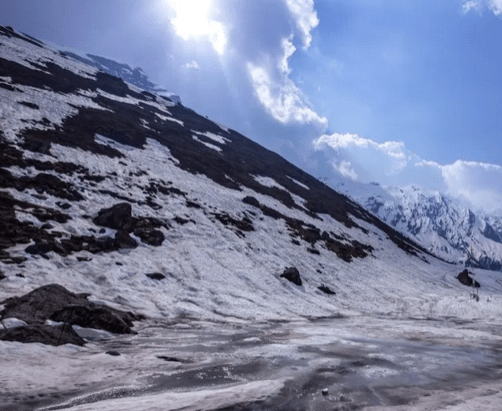
Trek to Kedarnath Temple is quite challenging and one actually needs a good fitness level to do it. The lofty snow-covered peaks, verdant grasslands, and River Mandakini makes the trek to Kedarnath unforgettable. The facilities and cleanliness on the way and at Kedarnath Temple are completely beyond expectations. Incredible India is definitely doing a great job to make Char Dham Yatra seamless.
Places of Interest on the way to Kedarnath
Devprayag – where Sangam of River Alaknanda and River Bhagirathi happens
Rudraprayag – where Sangam of River Alaknanda and River Mandakini happens
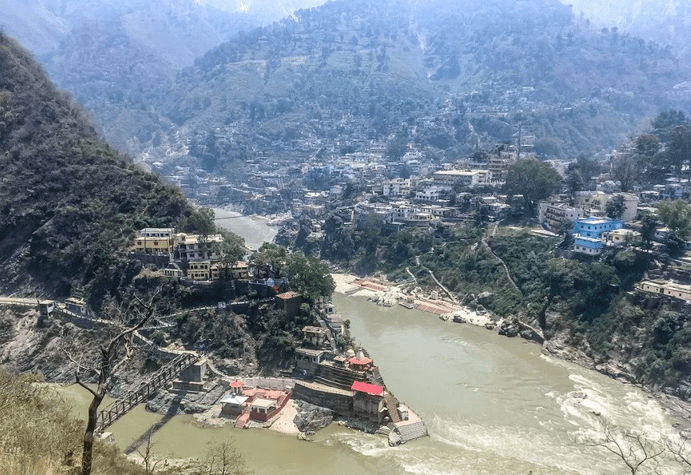
Sonprayag – where Sangam of River Basuki and River Mandakini happens
Agastmuni – 20 Kms from Rudraprayag is known for Agastmuni Templebuilt in the name of famous Saint Agastya
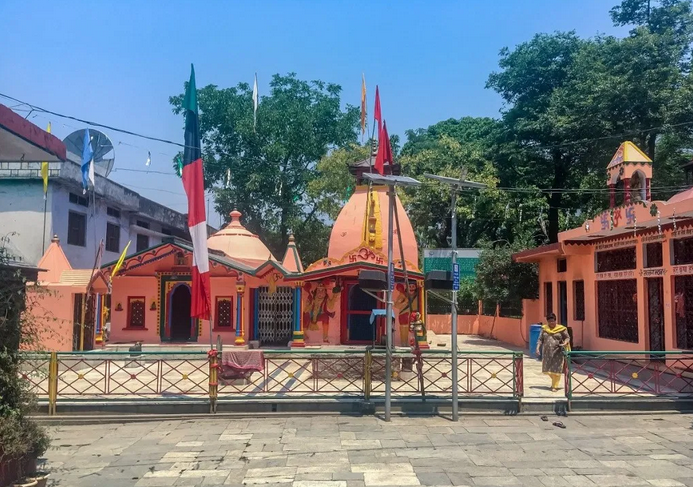
Guptkashi – is believed to be a place where Lord Shiva hid from the Pandavas. The place has two temples. Viswanath temple has several incarnations of Lord Shiva. Ardhanareeshwar temple, on the other hand, depicts Lord Shiva in the form of half man and half woman. In addition, there are two streams of water located in the temple, which symbolizes the two holy rivers, Ganges and Yamuna.
Gaurikund – The base camp to Kedarnath houses an ancient temple of Goddess Paravati. It is said that Goddess Paravati meditated here for a long time to win Lord Shiva as her husband. There is also a common hot water spring here. For Ladies, there is a separate one too but currently, it was not operational.
Ukhimath- is the winter abode of Lord Kedarnath and Madhyamaheshwar
Triyuginarayan Temple – located at a distance of 5 Kilometers from Sonprayag, is a Temple where Lord Shiva tied the knot with Goddess Parvati. Tourists visiting this sightseeing place can also make a visit to other attractions such as Vishnu Kund, Rudra Kund, and Brahma Kund.
 KedarnathCharDham